


The first condition for the development of any society is not merely the availability of resources. Before that, it is essential that the society has the right to decide what the priorities of its resources and its economy will be.
Before independence, India faced a very stark example of this. In 1943-44, when the country was facing famine and deaths, the country’s economic system was not in our own hands. The priorities of the government were different, and India was not in a position to decide its own priorities. Independence was therefore not merely political freedom; it was also the freedom to decide the direction of our own development.
Today, when we look back, this transformation is visible. A country that once struggled with food shortages has now reached a position where, even after an unprecedented disaster like COVID, it has the capacity to provide foodgrains to nearly 800 million people. This is not merely a number, but an indication of the journey of economic and institutional capacity that the country has built over a long period.
We should also look at this journey in the context of Jharkhand.
After becoming a separate state in 2000, Jharkhand got, for the first time, the opportunity to decide its resources, its needs and its priorities in its own way. The question now is how we have used this opportunity and how we can use it going forward.
In the direction in which the country’s economy has progressed, many changes have taken place after 2014, from the expansion of basic facilities to the use of technology, electricity, gas, highways, Bharatmala and systems such as GST. The journey from “Sabka Saath, Sabka Vikas” to “Viksit Bharat 2047” points towards a major economic transformation. Jharkhand cannot remain separate from this journey. It will have to determine its role in it according to its own circumstances.
And this is where the real question before us arises – how many resources does Jharkhand actually have?
We often answer this in terms of minerals.
Certainly, Jharkhand’s biggest economic identity is its mineral wealth. But if we consider only minerals as resources, then we are seeing only a very small part of our state’s actual potential.
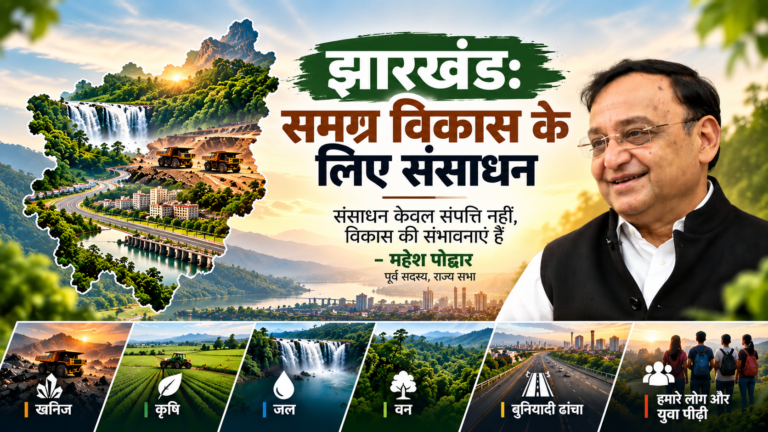
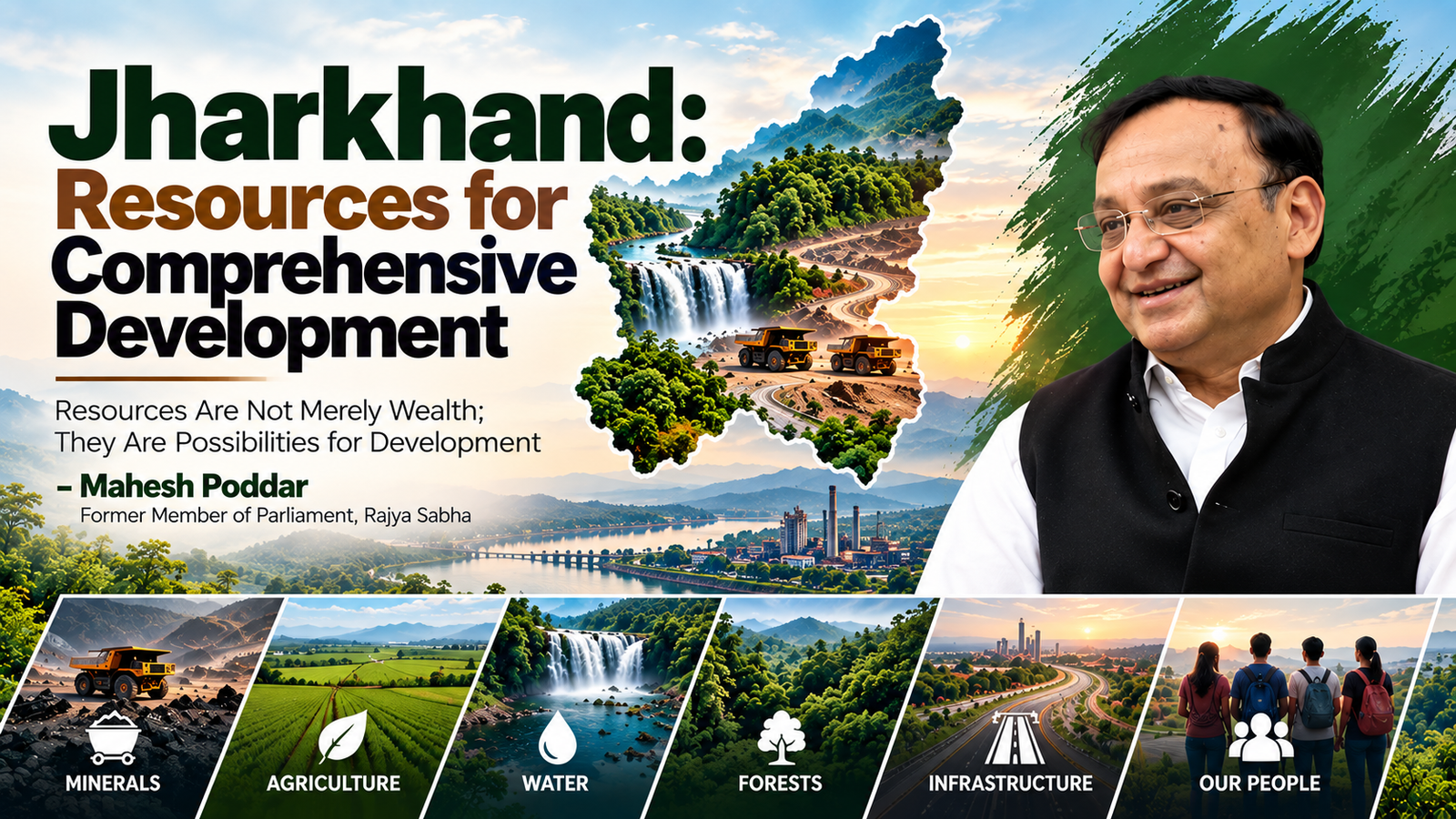
Land is a resource. Water is a resource. Forests are resources. Agriculture is a resource. And most importantly – our people and our younger generation are also resources.
Therefore, comprehensive development would mean that all these resources are viewed not separately, but as interconnected economic strengths.
Minerals are an important example of this.
Minerals are extracted from Jharkhand. But the greatest value of a mineral does not lie merely in taking it out of the ground. The real possibility arises when value addition is associated with it. If iron ore simply leaves the state, it will generate one kind of economic benefit; but if processing, steel, engineering, manufacturing and ancillary industries develop around the same resource, the economic value generated from that mineral can become many times broader.
That is, we should not ask only the question: what do we have? We should also ask: what are we making from it?
And then the next question follows from it – how much employment is being created from it, how much income is being generated, and how much is the state’s economy growing?
The same thinking also applies to minor minerals. If a resource is within our jurisdiction, its mere existence does not ensure economic benefit. The ability to use it better, manage it better and obtain better value from it is equally important. Obtaining a higher premium in an auction is not merely a question of the resource, but also a question of our policy and marketing capability.
Another balance is necessary when it comes to minerals.
Jharkhand’s minerals are important for Jharkhand, but their usefulness does not end at Jharkhand’s borders. The coal here generates electricity, iron ore makes steel, and steel is connected to the country’s roads, railways, industries, houses and even defence. Therefore, there is a natural relationship between Jharkhand’s minerals and India’s economy.
Jharkhand should receive a fair economic benefit from its wealth. But along with this, it must also be ensured that our policies encourage investment, industry and value addition. Taking a prosperous Jharkhand and a strong India together is the practical economic approach.
But our discussion of resources does not end here either.
Sometimes resources are right before us, but we fail to recognise them in that form.
Land is an example.
If land records are organised and regularised, legitimate houses and properties are properly regularised, and more productive use of land becomes possible, it will not only improve administrative systems. Economic activity can increase, the real value of property can emerge, and the government’s revenue base can also broaden.
Similarly, we should not view water merely as a natural element, but as an economic resource.
Water accumulated in an open coal mine may be a problem for someone today. But if the same water can be used safely and scientifically in some industrial activity, the same thing can be transformed into a new economic and human opportunity.
A resource is often already with us; the only requirement is to change the way we look at it.
And when we talk about resources, the state’s financial capacity must also be viewed from the same perspective.
Debt is not something unusual for a government. Borrowing to create infrastructure and productive assets has been part of the economic systems of governments around the world. But one thing is equally important – there must be a repayment plan along with the debt.
Along with this, government expenditure should also not be viewed merely from the perspective of continuously increasing it in the name of development. Spending is necessary for development, but it is equally important to continuously consider the necessity, priority and utility of every expenditure. The government’s financial capacity is limited, so it is not enough to see only how much can be spent; it must also be considered how much expenditure is actually necessary and where expenditure can be reduced or made more efficient.
Because many times, in discussions of development, higher expenditure itself is considered to mean greater development. Whereas the real question is what result came from the money that was spent. If funds have been sanctioned for a project, responsibility must also be fixed for its timely completion, proper implementation and use at full capacity. Merely making a provision in the budget or spending the amount cannot by itself be proof of development.
Jharkhand’s liabilities have increased considerably over the past years. During the pandemic, the debt-to-GSDP ratio went above 36 percent; the ratio has now come down, but the overall size of the debt is still significant.
Therefore, the discussion should not only be about how much debt there is. The question should be: what was created from that debt? How much was spent on it, how much of the work was completed, and how effectively is it being used?
Were assets created that will increase economic activity in the coming years? Will they generate employment and revenue? Will they increase the state’s future capacity? And is the state receiving the full benefit from the projects on which money has been invested?
Because government debt becomes more meaningful when it creates future productive capacity. And expenditure becomes meaningful when it does not merely exhaust the amount, but creates real improvement in the state’s capacity and in people’s lives.
In this context, the state’s own limitations must also be understood. The size of Jharkhand’s economy is still relatively small. Tax revenue has its own limitations, while on the other side there are commitments such as salaries, administrative expenditure and interest. Therefore, the question of how productive the use of every additional rupee is becomes even more important.
Here, the experiences and figures of neighbouring states such as Bihar and Chhattisgarh can provide us more of a reference than a comparison. The situation of debt and revenue differs across states. This means that the same policy does not produce the same results for every state. A better balance between revenue and expenditure has to be created according to one’s economic structure.
Therefore, taxation too should not be viewed merely from the perspective of increasing the tax rate.
At times, creating greater economic activity at a lower rate can be more effective. If the tax system is such that business and consumption increase, formal transactions increase and the tax base expands, then an increase in total revenue is also possible.
In Jharkhand, this approach can also be considered in areas such as excise and fuel taxation. The experiences of other states can help us understand that revenue is generated not only from rates, but also from economic activity.
But another point is equally important here.
Raising revenue is not the final goal of development.
The real importance of revenue is when it is reflected in people’s lives and in the state’s productive capacity.
DMF is an important example of this for mining-affected areas. Thousands of crores of rupees have been deposited under this mechanism in Jharkhand, but according to available figures, there has been a significant gap between the amount deposited and actual expenditure.
This should lead us to ask a very basic question – whether we have money or not is important; but even more important is how much of the money we have is actually visible on the ground.
Plans, budgets and provisions become development only when their impact reaches the people.
And this is where governance comes in.
The real value of any resource is not determined only by its market value. Its value is also determined by how efficiently it was used, how much economic activity it generated and how many people benefited from it.
Therefore, for Jharkhand to move forward, perhaps rather than searching for any one new resource, it will have to develop a culture of better utilisation of its existing resources.
We have minerals – so value addition should increase.
We have land – so records and utilisation should improve.
We have water – so new productive uses for it should be found.
We have financial resources – so borrowing should be converted into productive assets.
We have youth – so conditions should be created to make them not merely job seekers, but economic participants who create employment.
And we have India’s rapidly growing economy – so Jharkhand must connect its strengths with it.
This is where the meaning of comprehensive development emerges.
Comprehensive development does not mean merely more roads or more industries. It means creating an economic system in which resources create value, value creates investment, investment creates employment, employment increases income, income expands the market, and the market further strengthens the state’s economic capacity.
Jharkhand has to strengthen this cycle.
Today, we have both an opportunity and a responsibility before us.
As a separate state, we received the freedom to decide our priorities ourselves. Now there is a need for those priorities to show the prudent use of resources, financial discipline, value addition, entrepreneurship, employment and human development as interconnected elements.
Jharkhand should not be proud merely of how much mineral lies beneath it. It should reach a position where it can take pride in how much prosperity it has created from that mineral, that land, that water, that forest and, above all, its human resources.
In my view, this is the direction in which Jharkhand can build its next economic identity.
The resources are already with us. What is now required is – the right priority, the right policy and the right utilisation.
Only then will resources become development, and development will be visible not merely in figures, but in the lives of the people of Jharkhand.
A prosperous Jharkhand and a strong India – this should be the natural direction of our economic journey.
Resources Are Not Merely Wealth;
They Are Possibilities for Development
– Mahesh Poddar
Former Member of Parliament, Rajya Sabha